
A Comparative Analysis of Homelessness Coverage in Two Kansas-based News Publications
One day I wondered if I was being biased in my perception of a certain publication’s coverage so I decided to do a comparative analysis.
(“Are they really that bad or am I just being a hater?” - but academically).
The results were worse than I anticipated and solidified my decision to work in journalism.
Note: I now work for one of the publications I analyzed but I was not involved in the articles included in my study.
For some context, the Lawrence Journal-World and the Lawrence Times are both news publications that cover the Lawrence and Douglas County, Kansas area. Since they cover the same region they often cover some of the same stories, often with notable differences. This study quantified some of those differences.
For this analysis, I paired 36 articles on stories that each publication covered regarding the city-run North Lawrence campsite for people experiencing homelessness between November 2022 and April 2023. The articles included stories on the deaths of three camp residents, relevant city commission meetings, and general campsite news. Each story I included has a corresponding article at both publications, so it was a 1:1 analysis.
* The full study is HERE and the appendixes are HERE*
Source Analysis: Who is Represented?
I started by seeing how many unique sources (people) each publication cited in the articles.
A “unique” source just means not counting the same source twice. If a source is cited in multiple articles, they’re only counted once for this part.
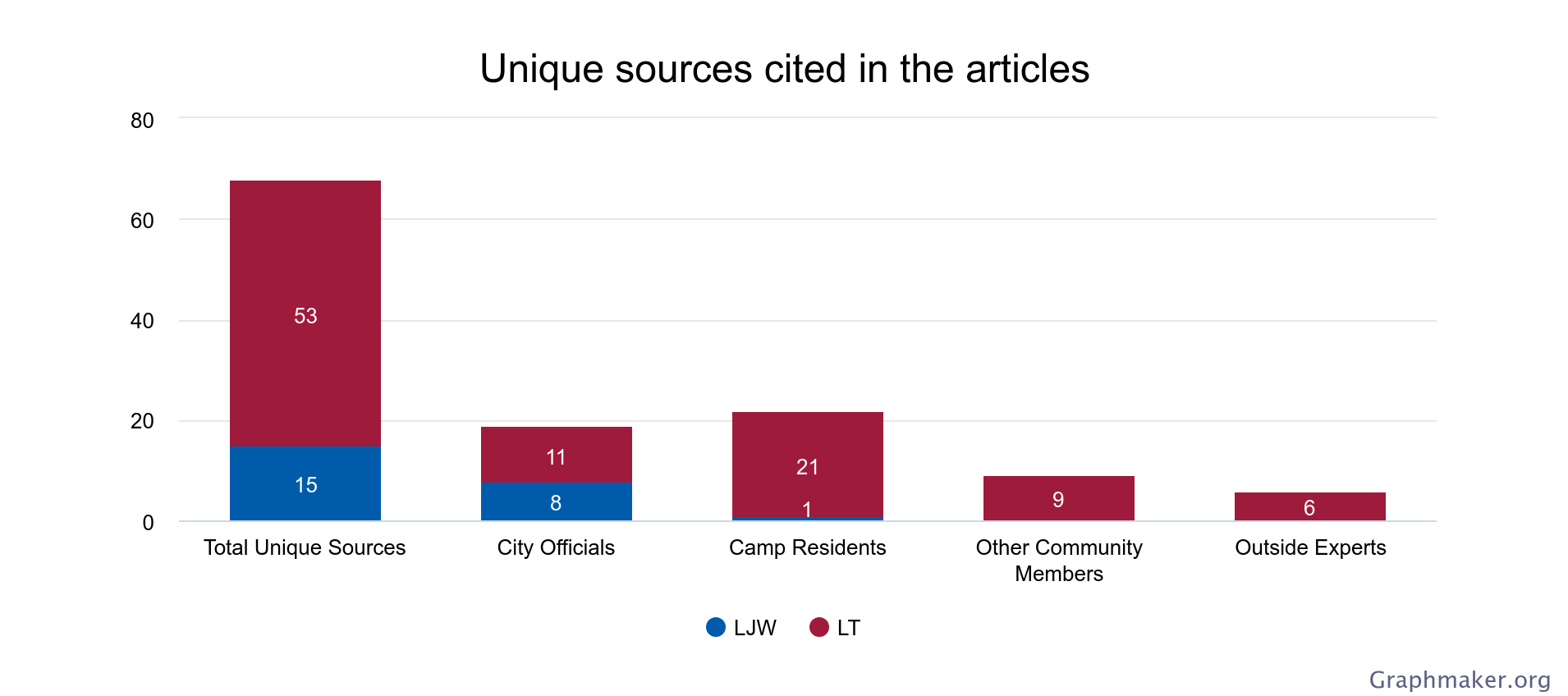
Across all the articles I analyzed, the Lawrence Times used a wider variety of sources, citing 53 unique sources, compared to the Journal-World, which only cited 15 unique sources. Lawrence Times also interviewed other community members (not camp residents or city officials) and contacted outside experts to add additional context, which the Journal-World did not.
Of those sources, the Journal-World cited eight city officials and one camp resident while the Times cited eleven city officials and 21 camp residents.
This stark difference suggests that the Times made it a priority to interview the people who are directly affected by the city’s decisions about the North Lawrence camp. I won’t (publicly) speculate on why the Journal World chooses to include or exclude people from their articles.
Who do they talk to when someone dies?
While reading and meticulously annotating the articles, I noticed significant differences in the sources used (people represented) in the stories about the people who died during the time frame of this comparison and want to highlight those differences specifically.

Susan Ford was 53 when she died in her tent at the North Lawrence campsite on November 21, 2022.
In the articles about her death, both publications cited city spokespeople and official statements and the Times also spoke with three of Susan’s friends and neighbors.
Tony Cipollaro died December 30th, 2022, just a few weeks shy of his 27th birthday.
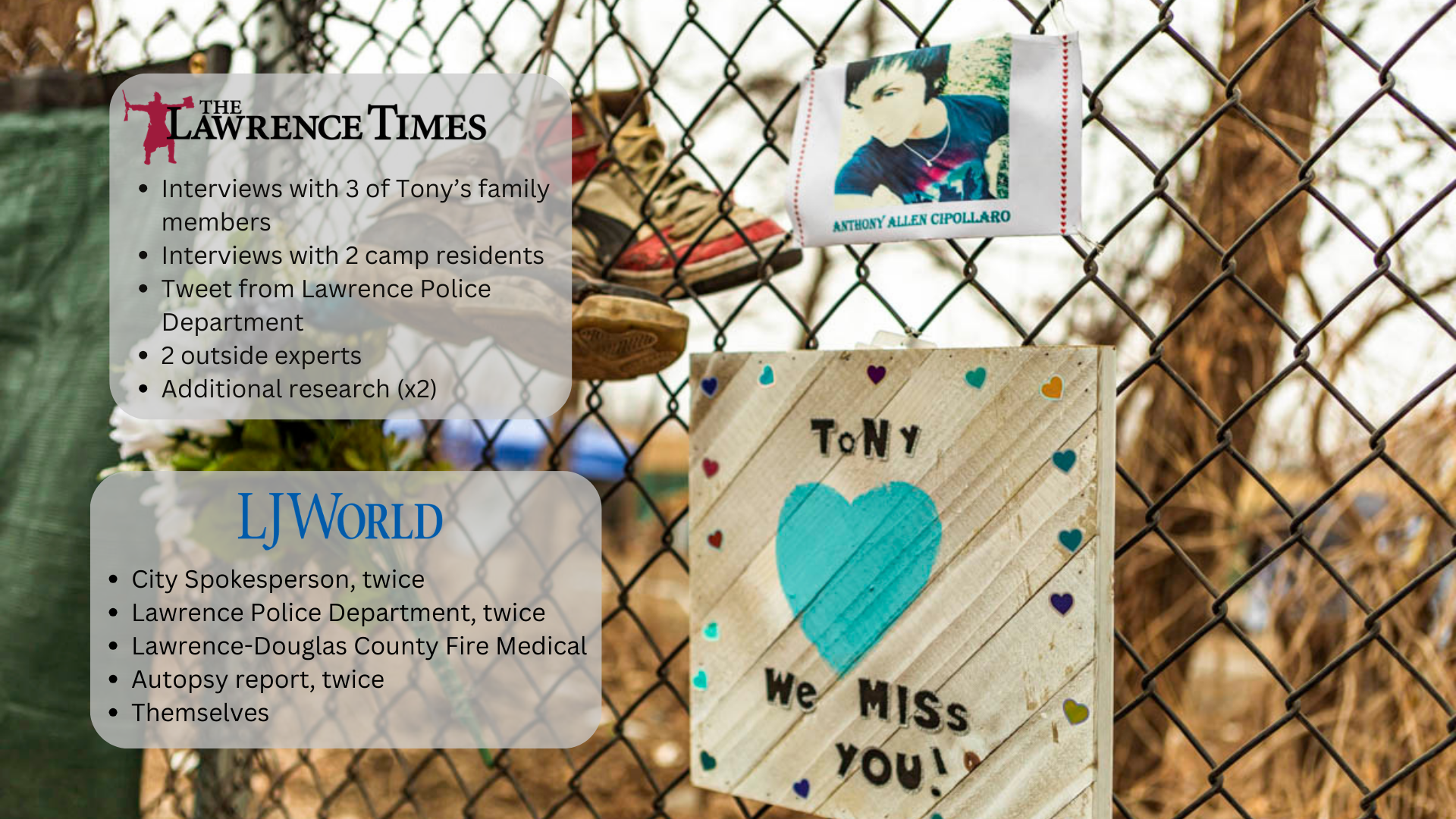
In the articles about his death, the Journal-World stuck to quoting city officials and official statements while the Times spoke to three of his family members and two of his neighbors.
Ashley Sawyer was found dead in her tent on March 21st, 2023. She was Cheyenne and Arapaho.
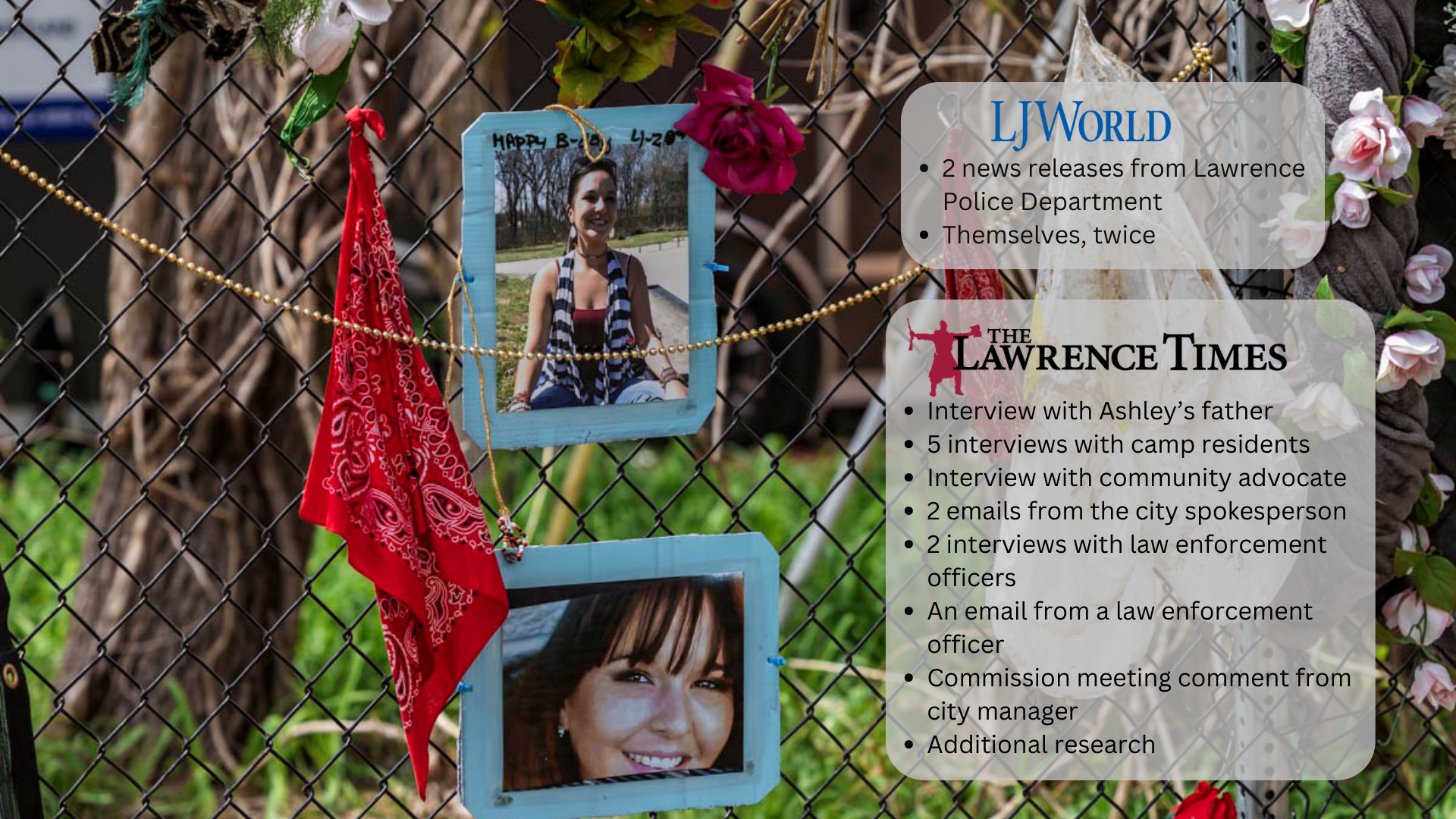
The Journal-World cited press releases and called it good while the Lawrence Times spoke with Ashley’s father, five of her neighbors, two community advocates, plus outside experts to add additional context, along with statements and interviews from city officials.
This is where the differences in reporting became staggeringly evident to me. It seemed like the Journal-World was doing the bare minimum while the Times wrote articles that provided insight into the person’s life and what they meant to others. They also didn’t just restate an autopsy report or press release, they contacted experts to provide context and awareness of the issues involved in the deaths.
Source Engagement
Wait, are they actually talking to people?
While reading these articles, I noticed yet another difference that I needed to look into: the level of interaction each publication seemed to have with their sources. So I added another category of analysis: source engagement.
Basically, how did the reporter interact with the source?
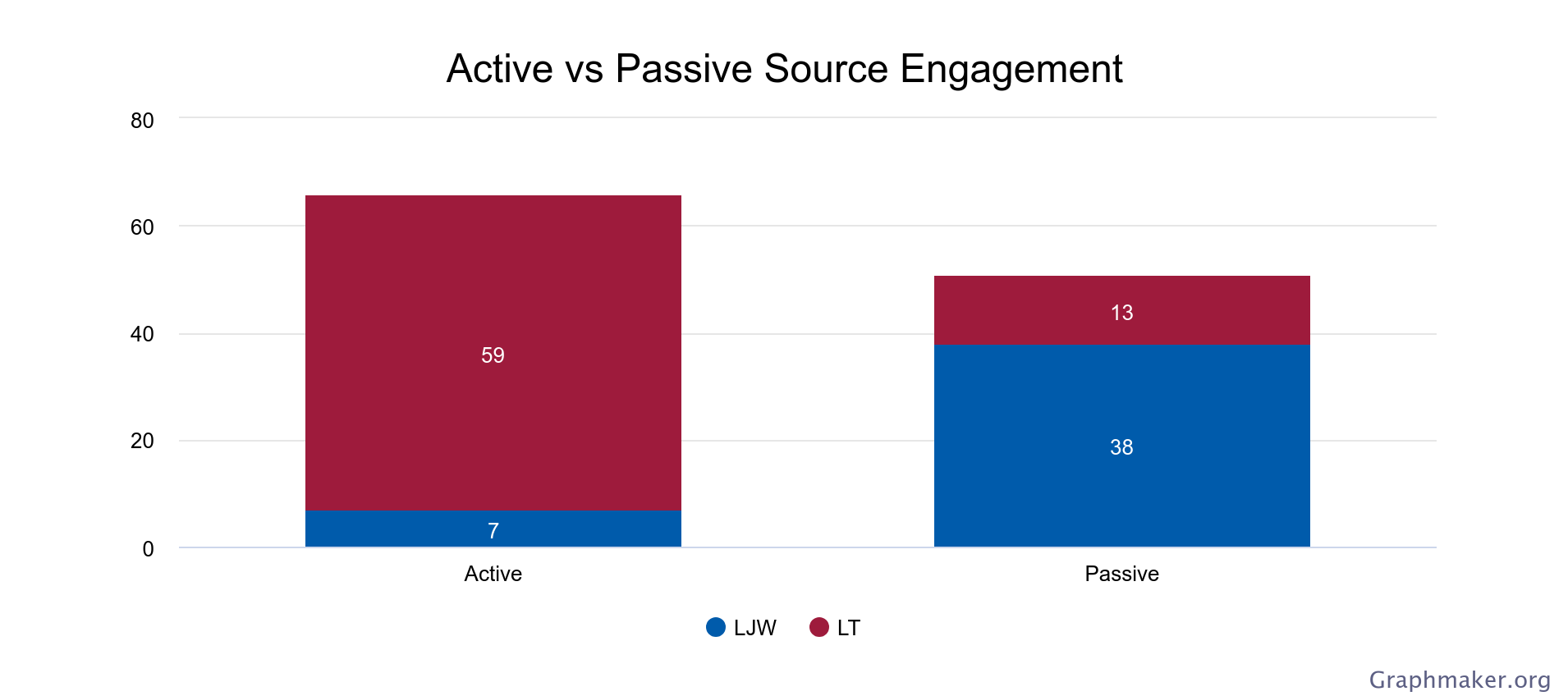
Active engagement includes correspondence between the reporter and another human being, such as in-person interviews, phone calls and on-the-scene reporting, while passive engagement includes sources that a reporter did not interact with, such as citing press releases, memos, or social media posts.
If it wasn’t clear how or if the reporter interacted with the source, I put it in the “unsure/other” category and did not include it in this count.
Despite having a smaller news team and presumably smaller budget than the Journal-World, The Lawrence Times actively engaged with 59 sources while the Journal-World only actively interacted with seven sources.
Based on the source and engagement analysis, it appears that The Lawrence Times has a more active engagement with the community and represents a more diverse range of voices while the Journal-World primarily reports from within the newsroom and relies heavily on pre-packaged information provided by city officials.
Of course, this is based on a small sample of articles, and press releases and social media posts are legitimate ways of getting information. However there is a lot to be gained from interacting with and listening to people, especially when you’re writing about things that affect them.
Word Analysis
Analyzing the representation and effort put into the articles was the more insightful and impactful part of this study, but if I’m quantifying things in written articles I might as well also analyze some of the words themselves, right? I mean, the data is right there, might as well take a look at it, right??
For the word analysis, I began by finding the cumulative word count and the count of unique words used for each publication across the 36 articles I analyzed. The Lawrence Times’ cumulative word count was 6,646 words higher than that of the Journal-World’s and the Lawrence Times’ count of unique words more than doubled the Journal World’s.
I didn’t read into that too much. Short articles and long articles both have their place and I was really just getting a baseline for the next part, which was word frequency.
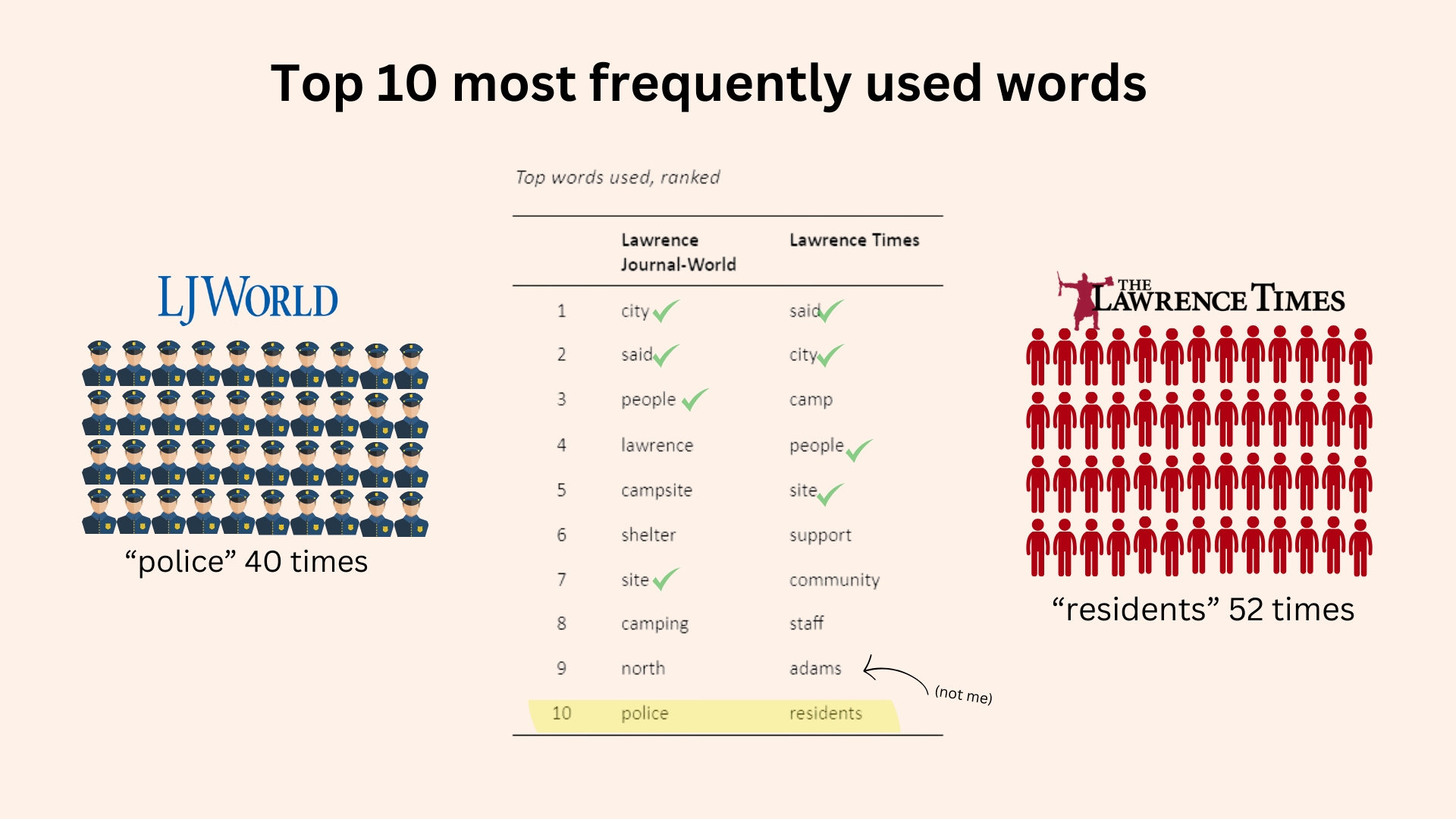
The top ten words used by each publication across all the articles I analyzed were overall similar except for a notable difference. The Journal-World’s tenth most frequently used word was police, with 40 occurrences, while residents was the Lawrence Times’ tenth most frequently used word, with 52 occurrences.
I won’t attempt to declare some profound meaning from that little tidbit, I just think it’s neat (or maybe indicative of representation priorities).
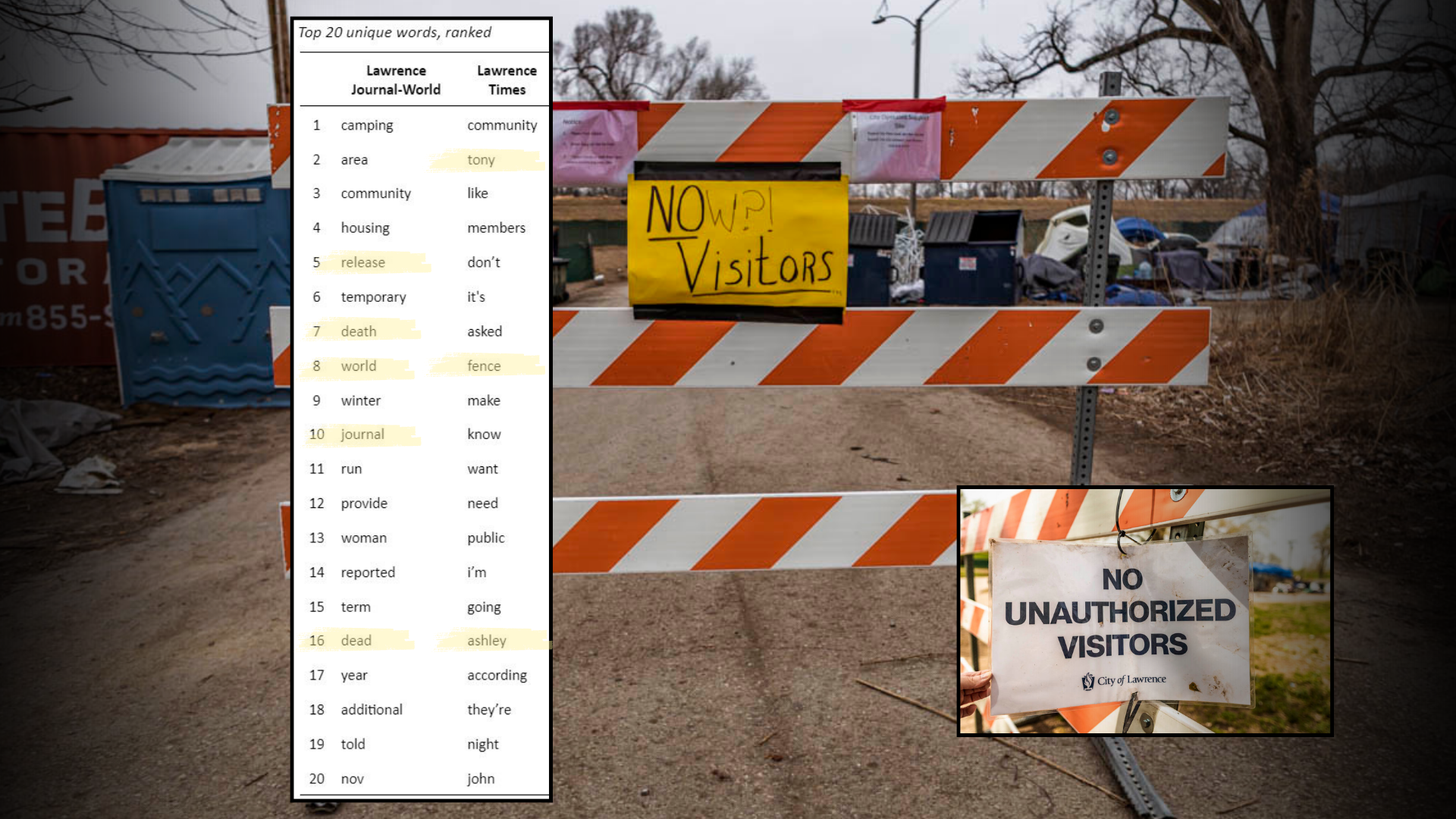
I then identified the top twenty words unique to each publication’s list of their fifty most frequently used words.
(Okay, follow me here: I made a list of each publication’s top 50 most used words.
Out of all the words they used throughout all the articles, these were the 50 words they used the most.
Then, from that list, I found which words were unique to each publication’s top 50 list.
I capped that list at 20 for my own sanity.)
I noticed that the words unique to the Times’ top list included the names of residents who died at the camp and “fence”, referring to an issue the camp residents found important, which was a fence the city put up around them.
Words unique to the Journal-World’s top list included dead, death, release, Journal and World, highlighting their prioritization of crime coverage, reliance on press releases, and an apparent commitment to referencing themselves.
****(I’m out of time for today and will finish adding info and formatting this later. Sorry!)
